
TECHNOLOGY
CHITOSE’s Strain Development Technologies Based on Diversification and Selection
In recent years, synthetic biology approaches centered on genetic recombination have become the mainstream approach to strain development. In addition to these approaches, we diversify gene sequences and strain genomes, then screen and select strains with improved characteristics, using an iterative approach to strain improvement.
Gene Introduction
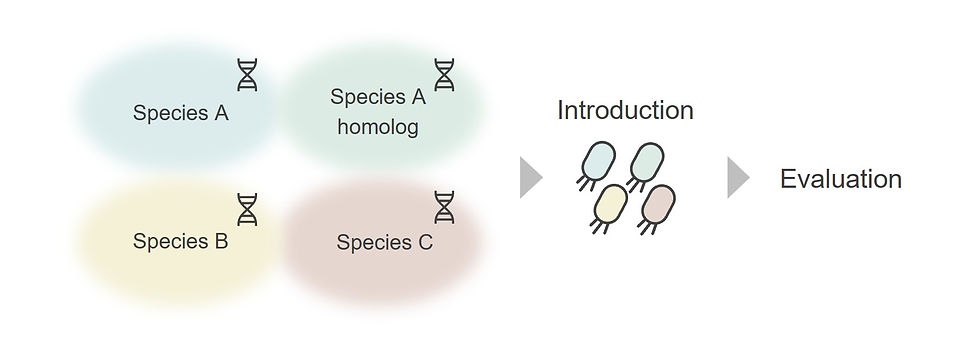
We select metabolic pathway genes to be introduced into the host. Because much remains unknown about the compatibility between host characteristics and the genes being introduced, we select multiple genes from diverse sources to introduce greater diversity.
Diversifying Promoters and
Translation Regulatory Factors
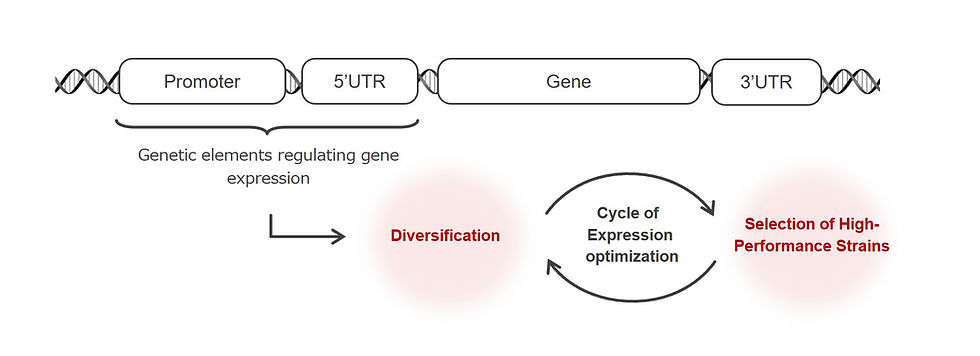
By diversifying gene promoters and translation regulatory factors using novel technologies, we can select elements that are better suited to the host’s expression machinery. This approach can be performed simultaneously with gene introduction. By diversifying promoters, translation regulatory factors, and genes independently, a substantial number of DNA combinations can be generated and tested at once.
TRACE-Based Enzyme Improvement
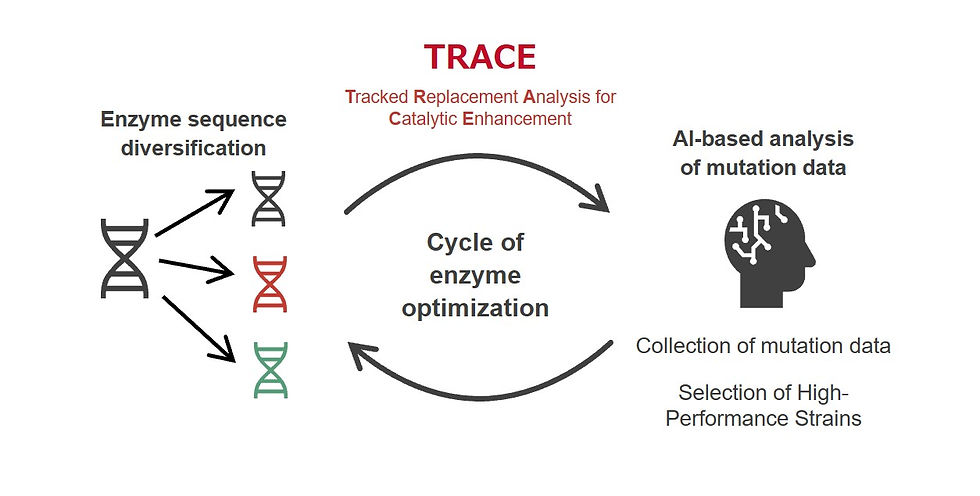
We developed TRACE (Tracked Replacement Analysis for Catalytic Enhancement) as a method for improving enzyme activity. Conventional approaches have used sequence and structural analysis of diverse variants to predict improved enzyme sequences. However, when existing databases are used, they often contain substantial sequence information that is not relevant to enzyme activity, making it difficult to accurately capture correlations between sequence and activity.
Our TRACE method enables data-driven enzyme optimization through our proprietary technology, which combines gene mutagenesis with AI-based analysis without relying on enzyme sequence information from existing databases.
Efficient Genome-Wide Optimization Through Disparity Mutagenesis
Introducing a large number of mutations and generating strains with diverse variations is essential for strain improvement. Our Disparity Mutagenesis method takes advantage of the fact that DNA replication on the lagging strand involves the complex synthesis of Okazaki fragments, resulting in the accumulation of replication errors on one side.
By artificially inducing this mechanism, we have developed a novel method for generating mutants that accelerates the evolutionary processes that occur naturally in living organisms. We apply this technology to the strain improvement of industrial organisms.
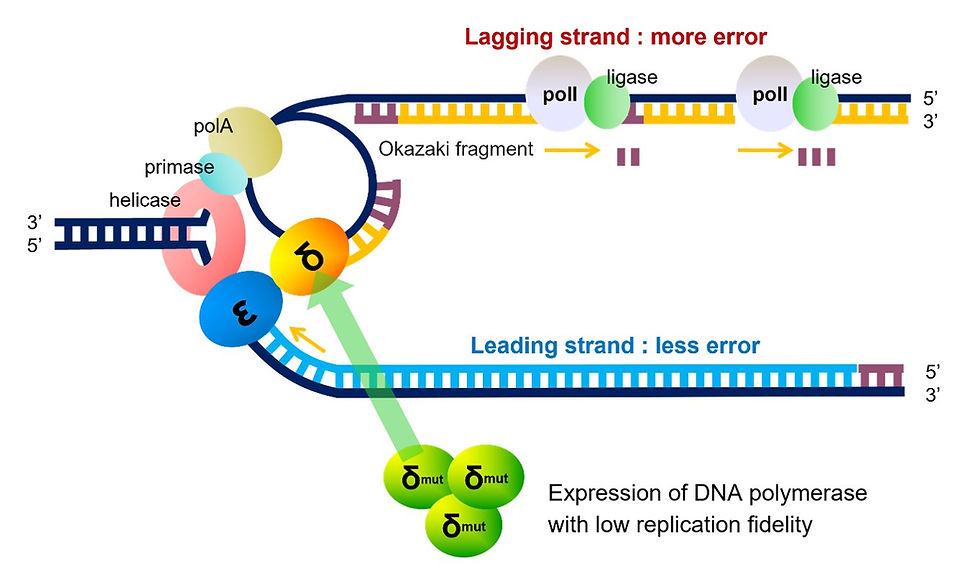
In double-stranded DNA, the leading strand tends to have fewer replication errors, while the lagging strand tends to have more. By expressing DNA polymerase with low replication fidelity and acting on the lagging strand, it is possible to further reduce the replication accuracy of the lagging strand alone.
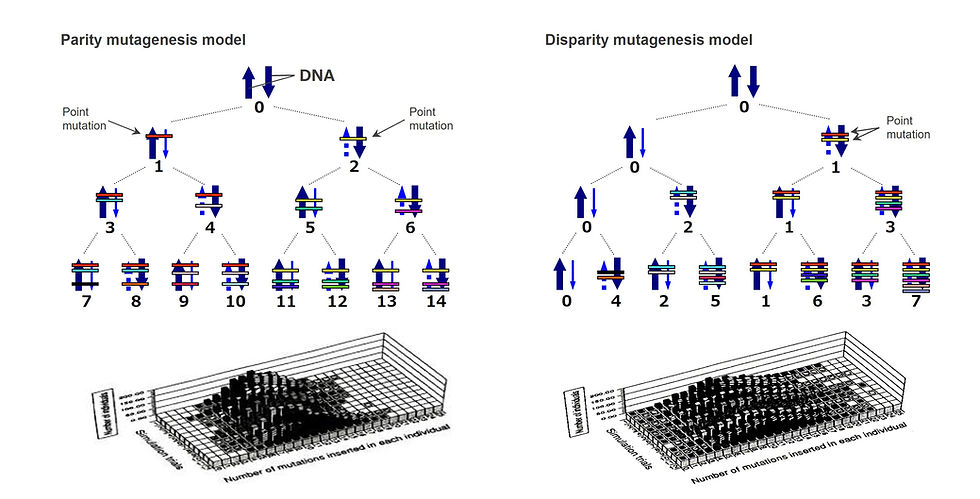
During DNA replication, the accumulation of mutations on only one side means that the template sequence is preserved. This allows for the introduction of additional mutations while maintaining sequences with traits suited to the environment. Simulation studies have shown that such disparity mutation accumulation leads to greater diversity compared to situations where mutations occur evenly.
Evaluation & screening
After generating strains with diverse characteristics, we evaluate them according to the objectives of the development. We have extensive proprietary expertise in this screening stage, enabling us to assess strain performance from multiple perspectives and select strains for the next cycle of diversification and selection.
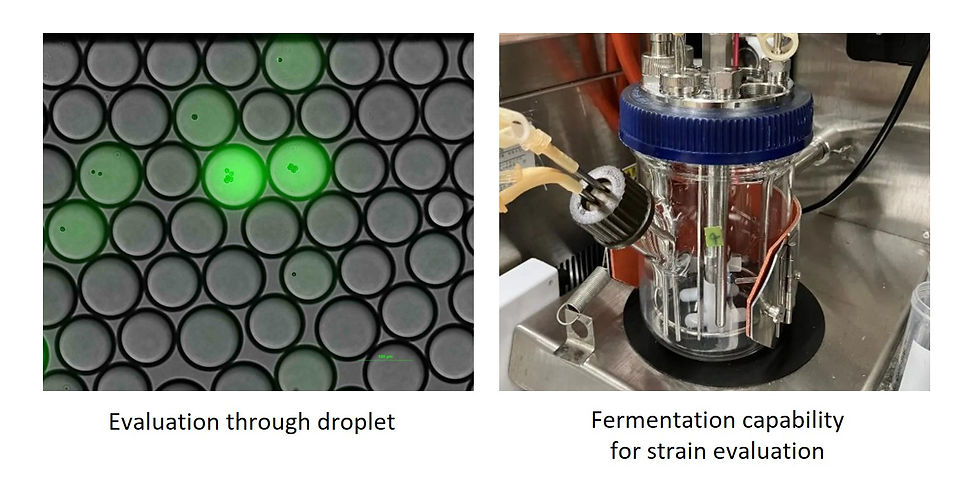
When high-throughput screening is required, we can rapidly evaluate large numbers of microorganisms and cells using droplet-based cultivation, in which extremely small droplets formed in oil serve as individual cultivation vessels.
When high-performing strains need to be identified, CHITOSE can leverage proprietary strain selection technologies, including tailored selective pressure, developed through years of accumulated expertise. This enables efficient selection of promising strains with the desired characteristics from large mutant libraries.
When strain performance needs to be evaluated under cultivation conditions, we can use jar fermenters to assess candidate strains, with subsequent scale-up to larger-scale production in mind.