

OUR APPROACH
Developing Strains That Deliver in Real-World Production
Why Is “Design” Alone Not Enough?
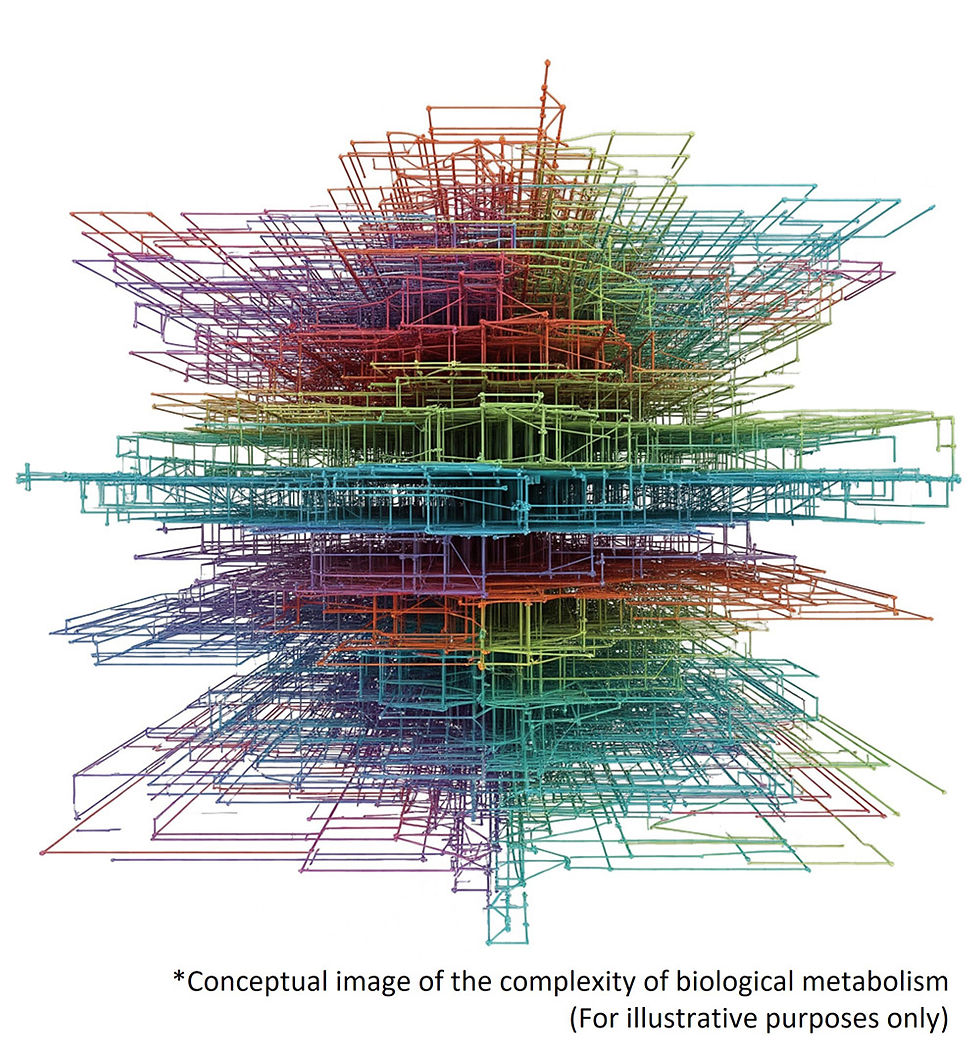
There is still a significant gap between being able to read a genome and being able to understand what it means.
Today, the prevailing view is that biological systems can be analyzed through data and therefore rationally designed. In reality, however, most of what happens within living organisms remains unexplained.
As a result, even when we design a target metabolic pathway and introduce the necessary genes, unexpected challenges emerge one after another—the product may inhibit other metabolic pathways, the product may be degraded, or enzyme expression may be regulated in ways we did not anticipate. Biological systems do not simply behave as designed.
Engineering the Unknown, Without Fully Understanding It
While we look forward to a future in which advances in synthetic biology may enable the design of entire production strains through synthetic biology alone, we believe that, for the foreseeable future, a combination of analytical and inductive approaches will remain essential for developing strains capable of delivering industrially relevant production performance.
Inductive approach
Engineer the unknown while it's still unknown.
Create diverse variants and discover the “right answer” through experimentation. Just as corn varieties have been improved through repeated diversification and selection, we create conditions that allow desirable traits to emerge, identify promising strains from a vast diversity of possibilities, and continuously select and develop them.
→
Breeding, mutagenesis, directed evolution
→
Selective pressure & cultivation design
→
High-throughput screening (biosensors, etc.)
Deductive / analytical approach
Understand everything, then build.
Predict and design the “right answer” based on theory and data. Using insights gained from genome analysis as a foundation, the desired metabolic pathways are rationally constructed.
→
De novo metabolic pathway design & FBA
→
Structure prediction (AlphaFold), AI-driven metabolic prediction
→
Synthetic biology, genome editing
Continuous Feedback and Iteration Between Strain Development and Cultivation
Even after a strain has been developed, unexpected challenges inevitably emerge when moving to larger-scale production. The key is whether the insights gained along the way can be fed back into strain development, allowing development to move forward through an iterative cycle between the strain and the production process.
Bioproduction development involves a range of technical areas, including strain development, cultivation, process development, and scale-up. Companies in the industry have developed different areas of expertise across this development landscape.
CHITOSE brings together capabilities and hands-on experience across these areas, connecting strain development, cultivation, process development, and scale-up as one continuous development cycle.
End-to-end bioproduction development technologies

CHITOSE’s Approach to AI-Driven Optimization of Cultivation and Production